
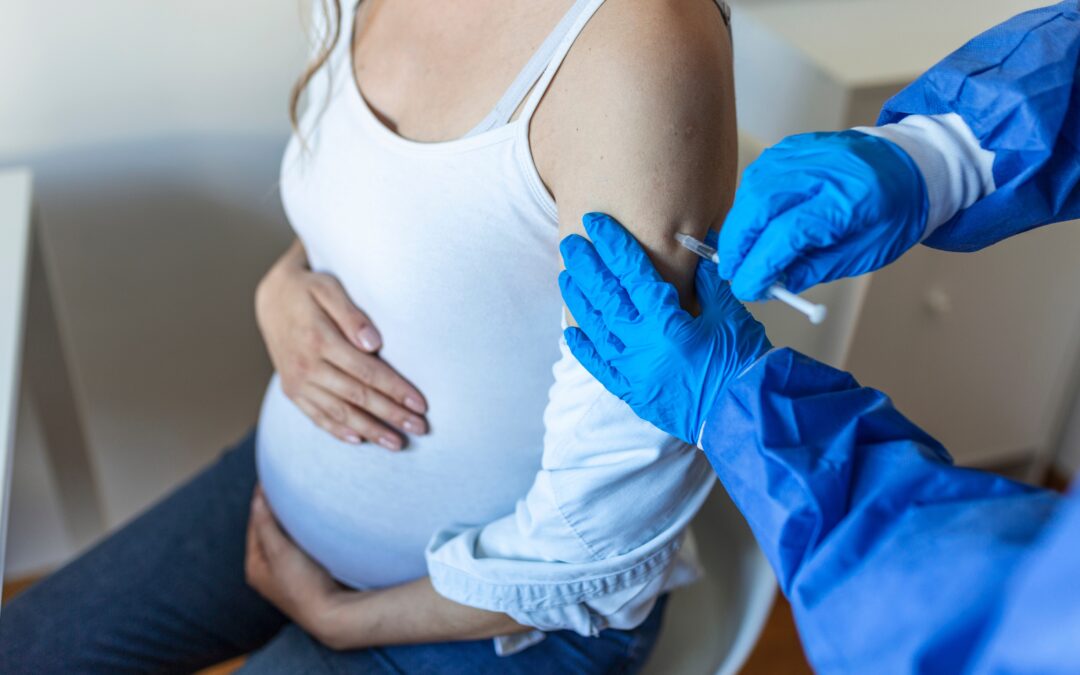
There are many unknowns about the effects of COVID-19 and the various vaccines on fertility, pregnancy, postpartum, and lactation health. This blog will primarily cover one specific aspect I’ve been researching—autoimmune hepatitis, COVID-19 vaccines, and pregnancy.
There are multiple case studies and accounts that describe the occurrence of autoimmune hepatitis soon after the administration of inactivated vaccines, viral vector vaccines, and mRNA vaccines (1, 2, 3, 4, 5, 6). (Click here if you’d like more information on the different forms of globally available COVID-19 vaccines.)
The proposed mechanism of action is molecular mimicry, i.e., viral proteins display similarly to self-proteins. The immune system mistakenly responds to self-proteins as it does against viral proteins, causing autoimmune-induced tissue damage (7).
To be clear, both the association of AIH and COVID-19 vaccines, and thus the proposed mechanism of action, are hypothetical.
Particularly concerning to me are studies that focus on COVID-19 vaccines as the primary trigger of an autoimmune phenomenon and seem to eschew the possibly greater risk of autoimmune reaction resulting from infection with the wild virus (8). This concern is also shared here (9).
Ultimately, I began to question the connections and possible implications of COVID-19 vaccine-induced autoimmune hepatitis and the functional liver changes that occur in pregnancy.
The liver and placenta affect the amounts of multiple proteins and enzymes commonly measured on blood tests during pregnancy. For instance, alkaline phosphatase is commonly seen in amounts twice that of what is found in non-pregnant people. Alkaline phosphatase may remain elevated postpartum until after breastfeeding is discontinued (10). For a more comprehensive list of functional changes in pregnancy, please refer to the resources below.
Reference Ranges in Pregnancy
- http://www.perinatology.com/Reference/Reference%20Ranges/Reference%20for%20Serum.htm
- https://www.ncbi.nlm.nih.gov/books/NBK6005/
The case study that led me to consider these implications was reported on a 3-months postpartum woman treated for hypertension during her pregnancy. She delivered her baby via an uneventful c-section. One week after her Pfizer vaccination, she was admitted to the hospital with yellowing of her eyes, jaundice, and enlarged liver, along with heightened bilirubin, AST, ALT, alkaline phosphatase, and positive ANA and dsDNA antibodies (1).
However, this article (11) points out the possible confounder of pregnancy, as autoimmune diseases are commonly initially observed in the postpartum period. Additionally, this and other case reports have noted that the characteristics of AIH reported near the time of COVID-19 vaccine administration present differently from typical AIH. It may be that these cases are occurring in predisposed individuals. Features of almost all case reports include elevated AST, ALT, bilirubin, and alkaline phosphatase.
While other cases of AIH have not been reported in pregnant or postpartum women, it may be essential to examine the overlap of functionally elevated blood markers in pregnant and lactating women and the elevated blood markers and liver findings in people presenting with possible post-vaccination AIH. Some questions I have about this overlap include:
- Would it be wise to first test a pregnant or lactating person’s AST, ALT, bilirubin, and alkaline phosphatase before vaccination?
- Is the risk of elevated liver enzymes and related compounds the same in infection with COVID-19 as it may be in vaccination?
- Are the periods of pregnancy and postpartum vulnerable times for those with a predisposition to autoimmune diseases, and could viral infection or vaccination trigger this tendency?
I’m continuing to research these questions and post updates to this blog as we learn more.
If you’d like more practical information on what labs to run during preconception, pregnancy, and postpartum, and how to accurately interpret lab test results during pregnancy, click here.
If you are overwhelmed or confused, make sure you reach out for help! You can learn more about my individualized client work here.
And if you’re a holistic healthcare practitioner looking to provide excellent client-centered support to children and adults with selective eating patterns, check out my case study group, where you can learn from me.
References
- https://www.ncbi.nlm.nih.gov/pmc/articles/PMC8056822/
- https://pubmed.ncbi.nlm.nih.gov/34717185/
- https://aasldpubs.onlinelibrary.wiley.com/doi/full/10.1002/hep.32269
- https://aasldpubs.onlinelibrary.wiley.com/doi/full/10.1002/hep.32280
- https://pubmed.ncbi.nlm.nih.gov/34225251/
- https://www.ncbi.nlm.nih.gov/pmc/articles/PMC8352654/
- https://www.ncbi.nlm.nih.gov/pmc/articles/PMC8547941/
- https://www.ncbi.nlm.nih.gov/pmc/articles/PMC7246018/
- https://www.ncbi.nlm.nih.gov/pmc/articles/PMC8352654/
- https://pubmed.ncbi.nlm.nih.gov/1216317/
- https://europepmc.org/article/pmc/pmc8098030